

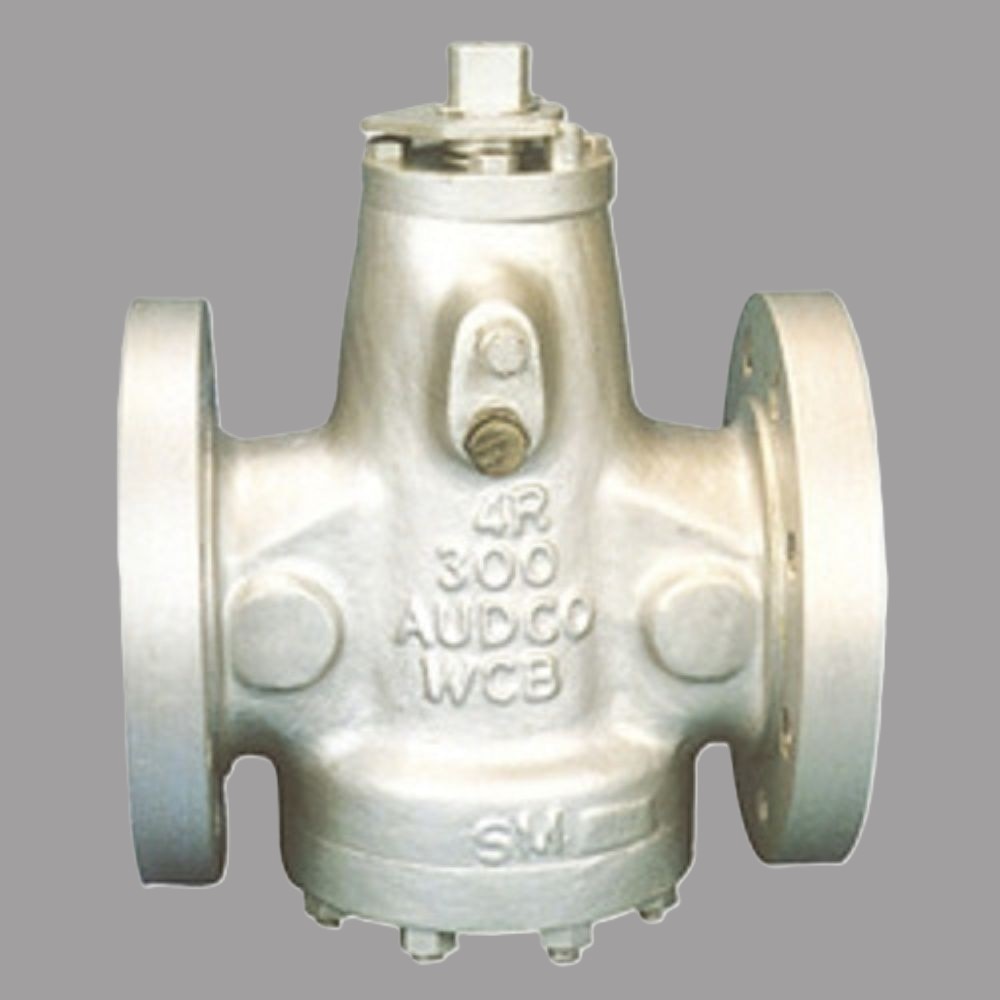
This plug valve is designed for the on/off and diverting service of liquids, gases, or slurries where a quarter-turn operation is useful. It uses a plug (instead of a gate or ball) to control flow. Because this version is in cast iron (CI) material, it’s more suited to moderate pressure/temperature services.
Construction & Materials
-
Body Material: Cast Iron (CI) — typical for the “CI Plug Valve” version.
-
Plug Type: Taper plug (in many standard Audco designs) with a shaving/metal-to‐metal seat or optionally a lubricant/filler around the plug to improve seal.
-
End Connections:
-
Screwed / Threaded ends for smaller sizes.
-
Flanged ends for larger sizes or more heavy duty lifting.
-
-
Size Range (for CI version): For example, “Regular Pattern” screw-end CI plug valves: ½″ – 2″ (15 mm – 50 mm) with Class 125/150 W.P.
Short pattern CI flanged: ½″ – 8″ (15mm–200mm) for Class 150 W.P. -
Pressure / Rating Example:
-
Light duty CI version: up to Class 125 working pressure.
-
Heavy duty CI version: up to Class 150 working pressure.
-
-
Operating Temperature & Service: For more advanced plug valve variants (not necessarily the basic CI version) the Audco Super-H series covers –46 °C to + 325 °C and high pressure up to 690 bar. While the CI version will be more limited.
Key Features
-
Quarter-turn operation allows quick flow interruption or diversion.
-
For the CI version, simple and economical construction suitable for moderate service.
-
Reliable sealing thanks to plug design and, in more advanced variants, metal-to-metal seats.
-
Can be used for on/off, diverting or bypass services.
-
Good for services where low head loss is needed (because the plug design offers a fairly open bore when full port).
-
For the heavier duty Audco plug valves, features include: metal-to-metal seats, wide seating areas for solids, pressure-balanced plugs for lower torque, and full inline maintenance.
Applications
-
General industrial piping for water, air, gas, low–medium pressure steam or fluids (for the CI version)
-
Especially in systems where corrosion or moderate mechanical stress is expected (cast iron suited here)
-
For more rigorous systems (higher pressure, temperature, solids in media) the higher alloy Audco plug valves are used.
-
Suitable for on/off/directional control rather than high precision throttling.
Selection / Specification Tips
-
Confirm material compatibility: Cast iron is less robust than steel or alloy when it comes to high temperature, high pressure, or corrosive service.
-
Confirm pressure class for your service (e.g., Class 125/150 for many CI versions).
-
Check end connection type (screwed vs flanged) based on your pipeline.
-
Confirm size range: ensure your nominal bore (NB) is supported by this valve version (CI version often ½″–8″ for certain patterns).
-
Confirm seat material / sealing arrangement: for abrasive or slurries you might need hard-faced plug, metal seats or special lining.
-
Consider operation & actuation: manual lever/wrench or gear/actuator if needed.
-
Check if full port (full bore) or reduced port is required depending on your flow/pressure drop requirements.
-
For critical services check test & certification: e.g., hydrostatic shell & seat tests. Some documentation shows seats tested per API standards.
