
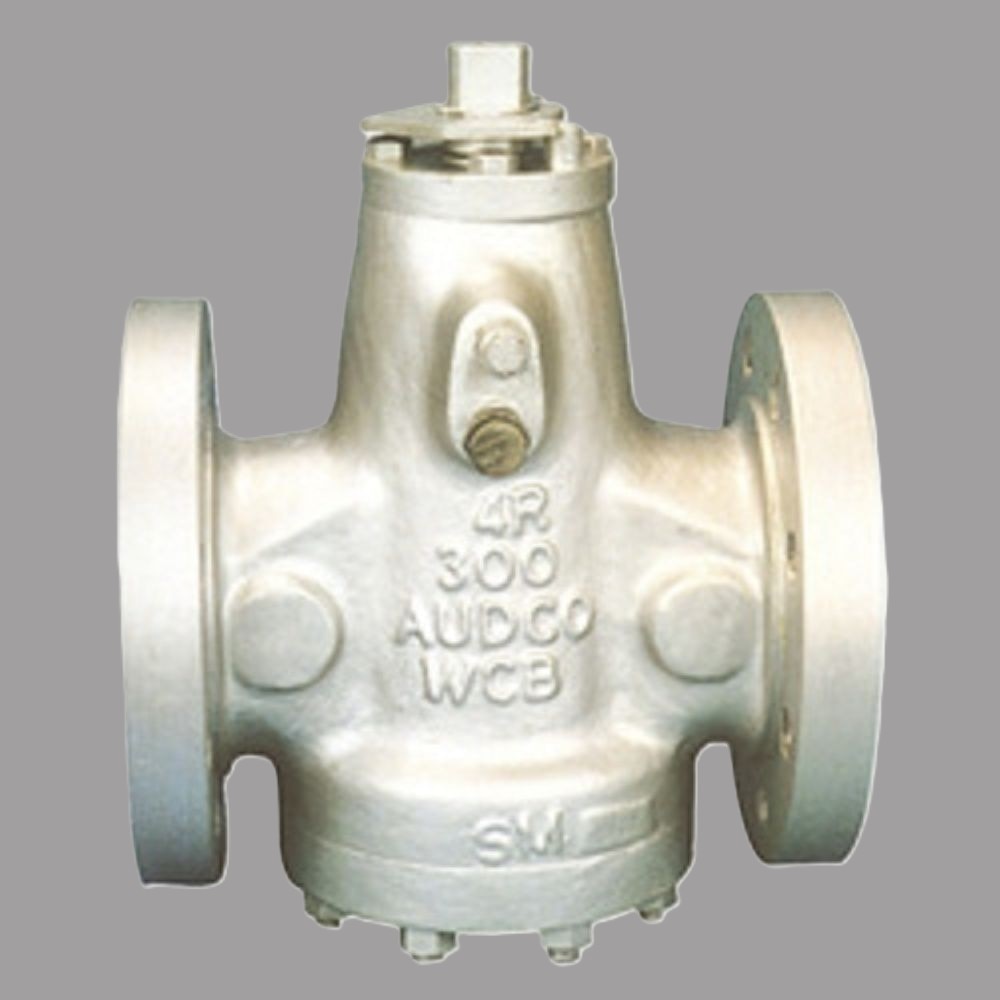
This plug valve is designed for the on/off and diverting service of liquids, gases, or slurries where a quarter-turn operation is useful. It uses a plug (instead of a gate or ball) to control flow. Because this version is in cast iron (CI) material, it’s more suited to moderate pressure/temperature services.
Construction & Materials
Body Material: Cast Iron (CI) — typical for the “CI Plug Valve” version.
Plug Type: Taper plug (in many standard Audco designs) with a shaving/metal-to‐metal seat or optionally a lubricant/filler around the plug to improve seal.
End Connections:
Screwed / Threaded ends for smaller sizes.
Flanged ends for larger sizes or more heavy duty lifting.
Size Range (for CI version): For example, “Regular Pattern” screw-end CI plug valves: ½″ – 2″ (15 mm – 50 mm) with Class 125/150 W.P.
Short pattern CI flanged: ½″ – 8″ (15mm–200mm) for Class 150 W.P.Pressure / Rating Example:
Light duty CI version: up to Class 125 working pressure.
Heavy duty CI version: up to Class 150 working pressure.
Operating Temperature & Service: For more advanced plug valve variants (not necessarily the basic CI version) the Audco Super-H series covers –46 °C to + 325 °C and high pressure up to 690 bar. While the CI version will be more limited.
Key Features
Quarter-turn operation allows quick flow interruption or diversion.
For the CI version, simple and economical construction suitable for moderate service.
Reliable sealing thanks to plug design and, in more advanced variants, metal-to-metal seats.
Can be used for on/off, diverting or bypass services.
Good for services where low head loss is needed (because the plug design offers a fairly open bore when full port).
For the heavier duty Audco plug valves, features include: metal-to-metal seats, wide seating areas for solids, pressure-balanced plugs for lower torque, and full inline maintenance.
Applications
General industrial piping for water, air, gas, low–medium pressure steam or fluids (for the CI version)
Especially in systems where corrosion or moderate mechanical stress is expected (cast iron suited here)
For more rigorous systems (higher pressure, temperature, solids in media) the higher alloy Audco plug valves are used.
Suitable for on/off/directional control rather than high precision throttling.
Selection / Specification Tips
Confirm material compatibility: Cast iron is less robust than steel or alloy when it comes to high temperature, high pressure, or corrosive service.
Confirm pressure class for your service (e.g., Class 125/150 for many CI versions).
Check end connection type (screwed vs flanged) based on your pipeline.
Confirm size range: ensure your nominal bore (NB) is supported by this valve version (CI version often ½″–8″ for certain patterns).
Confirm seat material / sealing arrangement: for abrasive or slurries you might need hard-faced plug, metal seats or special lining.
Consider operation & actuation: manual lever/wrench or gear/actuator if needed.
Check if full port (full bore) or reduced port is required depending on your flow/pressure drop requirements.
For critical services check test & certification: e.g., hydrostatic shell & seat tests. Some documentation shows seats tested per API standards.
