

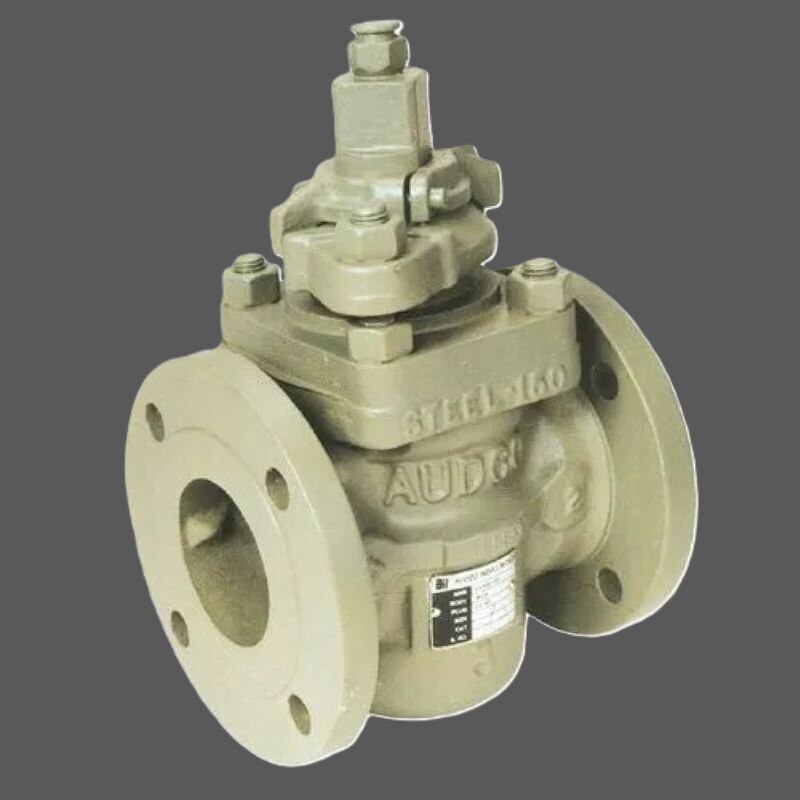
Description
The Audco Cast Steel Plug Valve is a quarter-turn valve designed for on/off, diverting and flow control services in industrial piping systems. Its robust construction and plug-type mechanism provide a straight flow path (when open) resulting in minimal pressure drop and reliable shut-off performance.
Construction & Materials
Body Material: Cast steel (e.g., ASTM A216 WCB) – offering strength and suitability for moderate to high pressure/temperature services. Supported by Audco’s “steel taper-plug” literature.
+4Plug & Seat: Tapered plug design (in many standard models) that seats into a matching bore. Some models incorporate PTFE or low-friction coatings (“Super LoMu” treatment) for smoother operation.
Connections: Flanged (RF), optionally screwed or butt‐weld depending on size and model. For example, flanged class 150 RF is typical.
Sizes: Common size range ~ ½″ to 12″ (15 mm to ~300 mm) for many models.
Pressure / Rating:
Many models rated for Class 150 (ANSI) or equivalent short-pattern.
Higher-duty models (Super-H series) support up to Class 2500 and severe services.
Temperature Range & Service Conditions: Depending on materials and trim, typical service might range from ~ –40 °C to +250 °C (or more for special alloys) for plug valves.
Features & Benefits
Straight flow path when open → minimal pressure drop and lower turbulence.
Quarter-turn operation → rapid open/close.
Robust metal-to-metal or sleeve seating (depending on model) for tight shut-off, even in challenging services (slurries, dirty fluids).
Suitable for manual operation (lever/gear) or actuated if required.
Short pattern options (reduced face-to-face length) for retrofits in systems originally designed for gate valves.
Typical Applications
Oil & Gas lines (on-off isolation, diversion)
Chemical & petrochemical process systems
Slurry service / abrasive media
Steam and utility systems
General on/off or diverting duty in industrial plants
Selection Tips
When specifying a plug valve of this type, consider:
Material compatibility: body, plug, seats must suit the fluid, temperature and pressure.
End connection type: flanged vs screwed vs butt-weld, ensure compatibility with piping.
Size & pressure class: ensure class rating (Class 150, 300, 600 etc) matches system design.
Flow conditions: for full flow (minimal drop) pick full-bore/port plug option; for throttling or diversion pick appropriate port shape (L-port, T-port if available).
Service conditions: if slurry/abrasive or high temperature/corrosive, choose premium trim (hard-facing, special alloy) or a higher series (e.g., Super-H).
Maintenance / accessibility: check if the design allows inline servicing or plug removal if needed.
Standards & testing: look for compliance to standards such as API 599 (Steel Plug Valves), ASME B16.34, ANSI/BS standards.
