
What Are GI Pipes
-
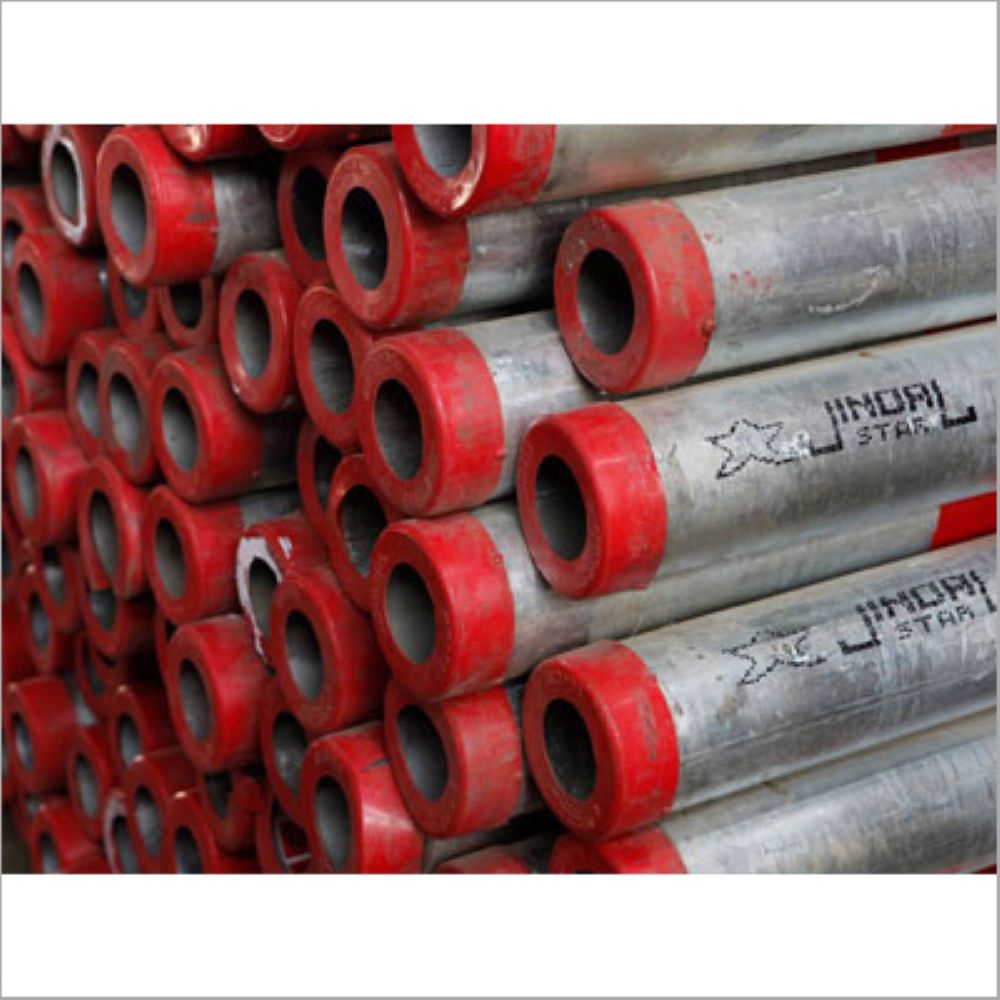
GI pipes are made from mild steel (low-carbon steel) that has been coated with a layer of zinc (galvanized). This zinc layer provides corrosion protection.+2
-
The process generally involves forming the pipe (ERW—Electric Resistance Welding) and then galvanizing, or galvanizing after welding, depending on product specifications.
Manufacturing & Standards
-
Manufactured by Jindal Pipes Ltd. (JPL) under the Jindal Star brand.
-
Sizes offered: From about ½″ (approx 15 mm NB) up to 14″ NB (and ERW black & galvanized pipes in some ranges up to 24″) depending on the plant and standard.+2
-
Wall thicknesses vary with the class of pipe (Light, Medium, Heavy) as per Indian Standard IS:1239 (Part-1) for GI / ERW pipes.+3
-
Other standards applicable: IS:1239, IS:3589, IS:1161; and international standards like BS, ASTM, API etc., depending on use and customer requirements.
Classes & Thickness (by IS:1239)
GI Pipes are classed as Light (Class A), Medium (Class B), and Heavy (Class C). These classes refer to wall thickness (for a given nominal bore). Some indicative size / thickness examples:
| Nominal Bore / Size | Outer Diameter (≈) | Light Class Thickness | Medium Class Thickness | Heavy Class Thickness |
|---|---|---|---|---|
| ½″ (15 mm) | ~21.3 mm | ~2.00 mm | ~2.60 mm | ~3.20 mm Textron Steel Alloys |
| ¾″ (20 mm) | ~26.7 mm | ~2.30 mm | ~2.60 mm | ~3.20 mm Textron Steel Alloys |
| 1″ (25 mm) | ~33.4 mm | ~2.60 mm | ~3.20 mm | ~4.00 mm Textron Steel Alloys |
| 2″ (50 mm) | ~60.3 mm | ~2.90 mm | ~3.60 mm | ~4.50 mm Textron Steel Alloys |
These are typical values; exact thickness depends on class & nominal bore.+2
Dimensions & Length
-
Standard length for most GI pipe offerings from Jindal Star is 6 meters.+2
-
Types of ends:
-
Plain ends
-
Screwed (threaded) ends — often used when connection to fittings is needed.
+2
-
Galvanization & Coating
-
The steel is coated with a zinc layer as per standard practices. The coating provides corrosion resistance; helps durability especially against rust, weather, moisture etc.
-
For Jindal Star GI pipes, the zinc coating is done as per IS:4736 (which prescribes required mass of zinc coating on certain steel products) in some cases.
Mechanical Properties
-
Tensile strength, yield strength etc. will vary depending on the thickness, material grade and process.
-
Some product listings state tensile strength of around 370 MPa and yield strength about 210 MPa for certain GI pipes.
-
The coating improves service life, but mechanical load capacity is mostly governed by the steel cross-section and wall thickness, not the zinc.
Applications & Suitability
-
Widely used in water distribution, plumbing, sewage, fire-fighting systems etc. because of corrosion protection.
-
Also used for structural purposes, engineering works, fabrication, electric poles, automotive, etc.
-
Especially useful in environments where moisture or corrosive elements are present (coastal, humid etc.). The zinc helps resist rusting.
Advantages & Limitations
Advantages:
-
Corrosion resistance due to zinc coating.
-
Longer service life vs plain MS pipes in wet or exposed conditions.
-
Easier to maintain.
-
Strong welds / joints (since ERW process).
-
Flexible in size, classes, end types.
Limitations:
-
Zinc layer can wear off or get damaged; once damaged, steel beneath can corrode.
-
Thicker GI pipes cost more due to more material and zinc.
-
Heavier than thin-walled pipes for same nominal bore (esp. heavy class).
