
Design & Standards
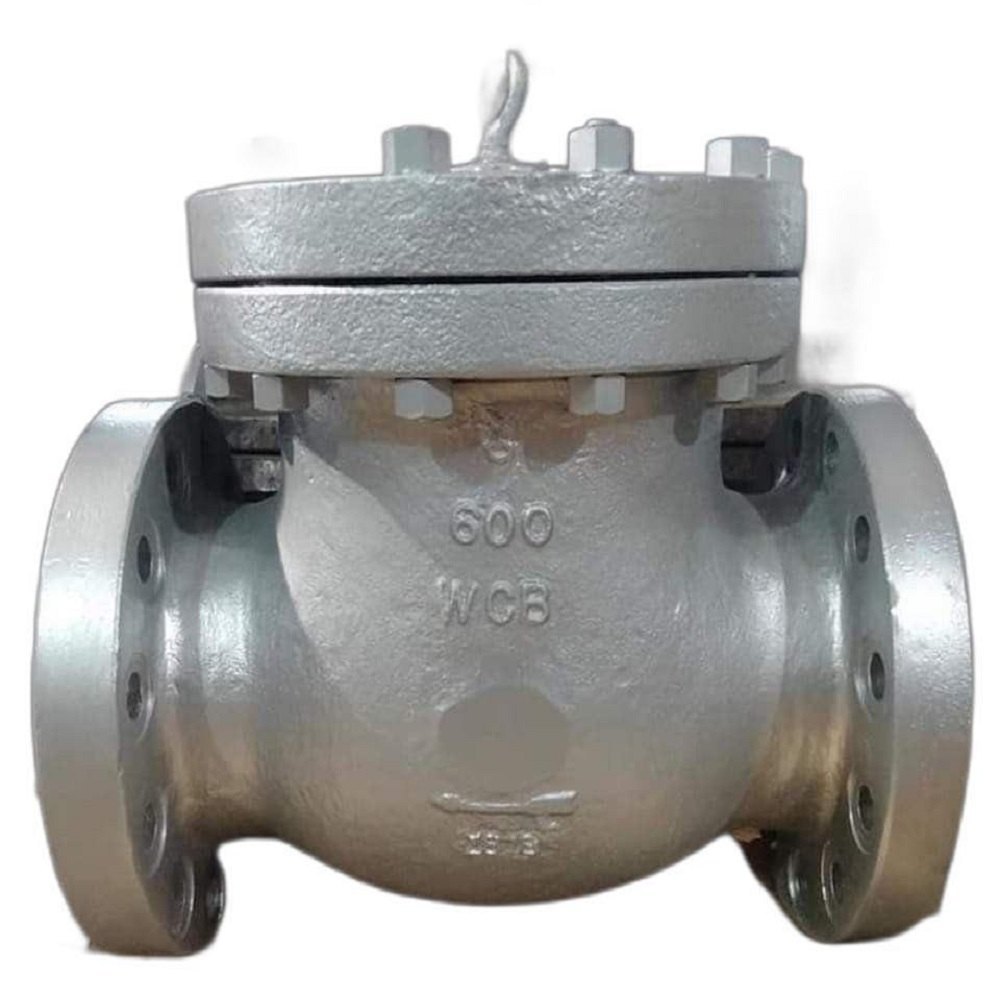
Standards: Designed according to BS 1868 and API 594, with ASME B16.34 compatibility
Pressure Classes: Available across ASME Class 150 to 2500
Construction: Features a robust bolted cover design, enabling easy maintenance and inspection
Materials of Construction
Body & Bonnet: Typically made of ASTM A216 Gr. WCB (cast carbon steel)
Trim & Wear Components:
Disc: 13% Chromium steel for enhanced durability
Seat Ring: Steel (A105) with Hard-Facing (HF), often Stellite #6, to resist wear
Hinge and Pin: Internal hinge using WCB or corrosive-resistant steel, secured by a lock nut and pin
Gasket: Spiral-wound with SS316 and graphite filler between body and bonnet
Technical Features & Operation
Flow Efficiency: The swing disc is designed to fully swing open downstream, minimizing resistance and erosion
Internal Hinge Design: Ensures higher integrity (no external holes), reducing potential leak paths
Disc Mobility: The disc is free to rotate, allowing even wear and extending service life
Testing & Approval: Typically tested as per API 598 leak-tightness standards; may carry API monogram and comply with ISO 15848-1 for fugitive emissions
Regulatory Compliance: Conforms to PED Annex III Module H (EU) and has been tested per Shell 77/300 inspection protocols
Size & Connection Options
Size Range: Available in nominal sizes from 2″ to 36″ (DN 50 to 900)
End Connections:
Flanged Ends: ASME B16.5 RF (Raised Face)
Butt-Weld Ends: ASME B16.25, available in higher classes
Typical Application Settings
Ideal for preventing backflow in oil & gas, power generation, petrochemical, refinery, water, and steam systems
Installation Types: Suitable for both horizontal and vertical upward flow pipelines
