

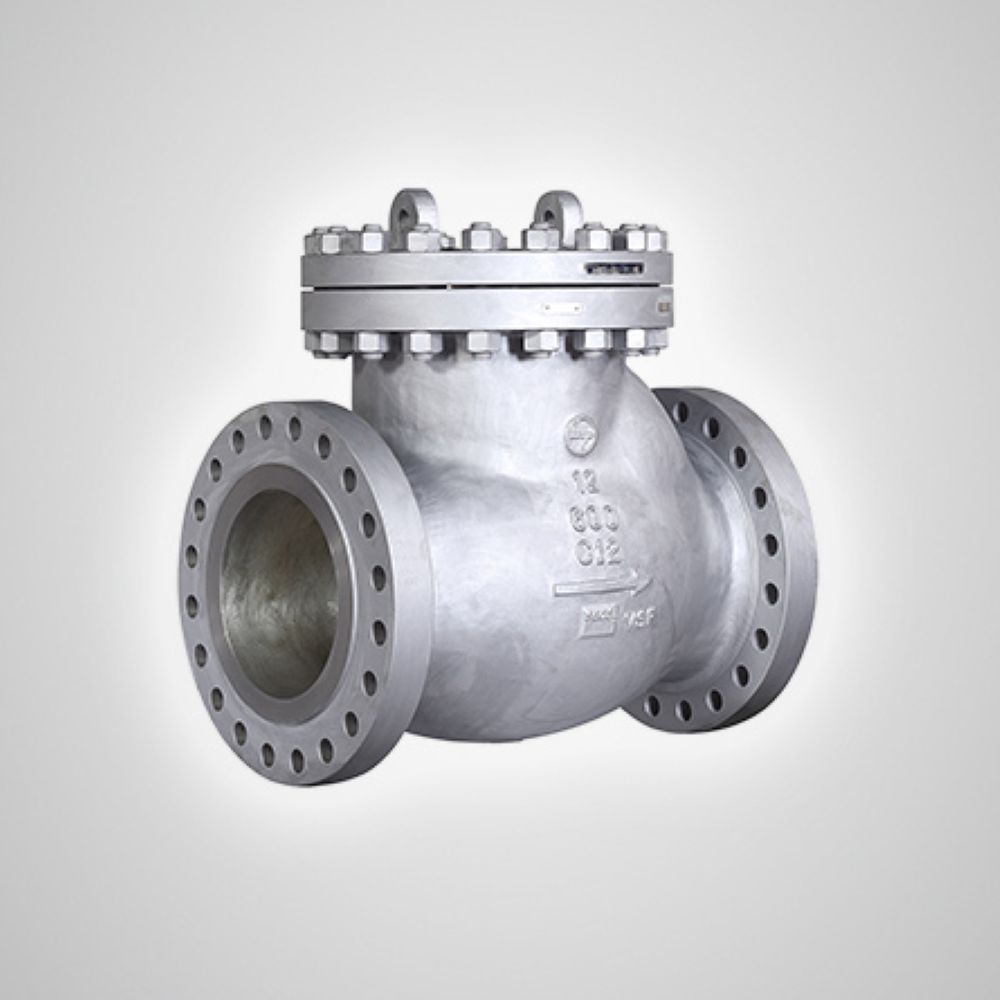
What is a Swing Check Valve
A swing check valve is a type of non-return (check) valve in which the disc (or flap) “swings” on a hinge/axis to allow forward flow and swings back under gravity (or reverse flow) to close and prevent backflow. In L&T’s implementation:
-
The disc is internally hinged, so there is no external opening in the valve body. This helps in maintaining body integrity and avoiding leakage paths.
-
The seating surfaces are often hard-faced (e.g. with Stellite-6 or equivalent) for wear resistance and tighter sealing over time.
-
The valve may use pressure-seal body–cover joints and seal-welded seat rings to eliminate leakage paths between the body and seat.
Design & Construction Characteristics
Here are key design and construction features from L&T’s documentation:
| Feature | Description / Detail |
|---|---|
| Body–Cover / Bonnet Design | For high pressure classes, L&T uses a pressure-seal body/cover joint where internal pressure helps tighten the gasket. |
| Seat Rings | Standard is seal-welded seat rings (i.e. seat ring welded to the body) to avoid loosening or leakage.+2 |
| Disc / Hinge | The swinging disc is mounted via internal hinge (no external hinge opening) so flow is unobstructed and integrity is maintained.+2 |
| Hard-Facing / Trim Materials | Seating surfaces are hard-faced (e.g. Stellite #6 or equivalent) to resist wear and maintain sealing over cycles. |
| Flow & Closing Action | The valve opens by the velocity of the medium (forward flow). On flow reversal or stoppage, the disc swings back by gravity (or assisted by spring if present) to close.2 |
| Installation Orientation | These valves can be used in vertical (upward flow) or horizontal pipelines. They should not generally be used in downward flow orientation.+2 |
| End Connections | Available in flanged, butt-weld (BW) ends (ASME B16.25), plus other standard connections per customer specification. L&T Valves +3 |
Size, Pressure Classes & Range
L&T offers swing check valves across a broad range of sizes and pressure classes. Some of the ranges from their manuals:
| Size (Nominal) | Applicable Pressure Class / Ratings |
|---|---|
| 2” to 30” (≈ DN50 to DN750) | Class 150, 300, 600 |
| Up to 36” in some classes | For class 300 check valves, size up to 36” is mentioned. |
| Higher pressure / more severe service | Pressure-seal variants in higher classes (900, 1500, 2500 etc.) are possible per L&T’s “Gate, Globe & Check Valves – Pressure Seal” manual. |
They also support a broad materials range:
-
Cast steel / forged steel bodies (ASTM A216 WCB etc.)
-
Stainless, alloy steel, or special material trims on request
Testing, Standards & Quality
L&T’s swing check valves conform to several international and industrial standards and testing regimes:
-
Design & manufacturing according to ASME B16.34, API 600, API 598 for pressure, testing, etc.
-
End dimensions (flanges) per ASME B16.5; butt-weld ends per ASME B16.25.+2
-
Hydrostatic and low-pressure closure tests are done, e.g. for check valves, a low pressure closure test at ~ 25% of the full test pressure is done.
-
Bolted-bonnet or pressure-Seal designs depending on class.+2
-
Identification plate (nameplate) with pressure & temperature ratings, material, direction arrow, etc.
Operation, Maintenance & Installation Notes
Some practical guidelines and features from L&T’s manuals:
-
Before maintenance or disassembly, ensure the line is depressurized and drained.
-
Valves are shipped with the disc fixed (using stoppers) to prevent damage during transport.
-
Routine inspection includes checking for leakage at body-cover (or cover) joints, condition of seat/disc, hinge pin, etc.+2
-
For check valves, the cover (or plate) is removed to access the internal disc/hinge for service — simpler than gate/globe where bonnet removal is needed.
-
Care must be taken in orientation (flow arrow) and avoid installing such valves in orientations that make the disc seating ineffective.
-
Periodic retightening or checking of gasket bolting is suggested, particularly after initial pressure-up.
Advantages & Limitations
Advantages:
-
Simple, robust design with few moving parts
-
Internally hinged disc avoids external leakage paths
-
Hard-faced seats allow long service life in demanding conditions
-
Suitable for high pressure / high temperature if designed appropriately
-
Quick response to flow reversal
Limitations / Considerations:
-
May produce a “slam” on reverse flow (disc hitting seat) in some cases unless properly damped
-
Sensitive to flow direction and orientation
-
For pulsating or reciprocating flow, disc chatter may occur+2
-
For very large sizes in high class, weight and hinge design become critical
